
Conduz pesquisas nas áreas da Psicologia Organizacional e do Trabalho e da Educação. No contexto laboral, investiga o bem-estar e os resultados organizacionais, com ênfase no Modelo de Demandas-Recursos no Trabalho (JD-R), além do desenvolvimento e validação de instrumentos psicológicos. Na Educação, desenvolve pesquisas voltadas à compreensão de fenômenos, experiências e práticas educacionais. Possui interesse em pesquisas com métodos mistos, integrando abordagens quantitativas e qualitativas para uma compreensão mais ampla dos fenômenos investigados.
Entre em contato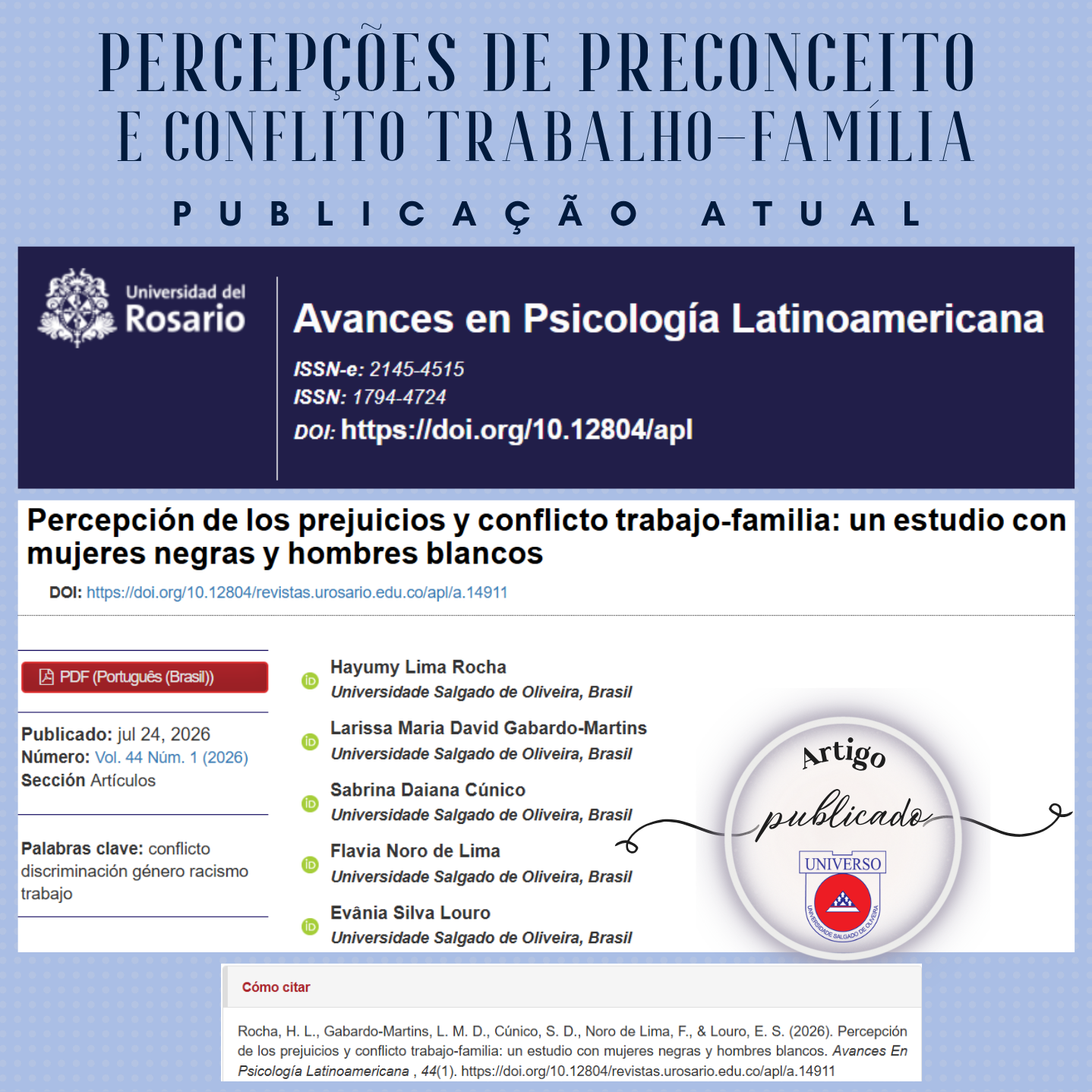
Obteve o título de Doutora (2025) e Mestre em Psicologia (2022) pela Universidade Salgado de Oliveira.
Possui diversas especializações, incluindo: Tutoria em Educação a Distância pela Universidade Federal do Mato Grosso do Sul (2025), EAD e Novas Tecnologias Educacionais pelo Centro Universitário UNIFATECIE (2024), Direito Civil, Penal e Processual Penal pela Faculdade IBRA (2020), Ensino de Língua Inglesa pela Universidade Cândido Mendes (2015) e MBA Profissional em Comportamento Organizacional pela Escola Superior Aberta do Brasil (2013).
Possui formação multidisciplinar, sendo graduada em Psicologia pelo Centro Universitário La Salle (2026) e em Direito pela Universidade Salgado de Oliveira (2020). É também licenciada em Letras – Português, Inglês e Literaturas e bacharela em Secretariado Executivo Bilíngue pela Pontifícia Universidade Católica do Rio de Janeiro (PUC-Rio), títulos obtidos em 2004.
Rocha, H. L., Gabardo-Martins, L. M. D., Cúnico, S. D., Noro de Lima, F., & Louro, E. S. (2026). Percepción de los prejuicios y conflicto trabajo-familia: un estudio con mujeres negras y hombres blancos. Avances En Psicología Latinoamericana , 44(1). https://doi.org/10.12804/revistas.urosario.edu.co/apl/a.14911
En la actualidad, las mujeres negras representan el mayor grupo demográfico en Brasil. A pesar de ello, presentan las peores condiciones laborales. Además, continúan siendo las principales responsables de las tareas domésticas, incluso cuando mantienen elevadas jornadas de trabajo. Con base en estas consideraciones, el presente estudio tuvo como objetivo comparar los niveles de percepción de discriminación cotidiana, negación del prejuicio, afirmación de diferencias y conflicto entre el trabajo y la familia entre cuatro grupos definidos por la intersección entre raza y género: hombres negros, mujeres negras, hombres blancos y mujeres blancas. Participaron 628 trabajadores/as brasileños/as, de los cuales el 17.5 % eran hombres negros, el 38.7 % mujeres negras, el 14.2 % hombres blancos y el 29.6 % mujeres blancas, con edades entre 18 y 73 años. Debido a la no normalidad de los datos, los análisis se realizaron mediante la prueba de Kruskal-Wallis, con comparaciones post hoc de Dunn y corrección de Holm, reportándose tamaños del efecto e intervalos de confianza. Los resultados evidenciaron que las mujeres negras presentaron mayores niveles de discriminación cotidiana, mientras que las personas blancas tuvieron los niveles más bajos de esta experiencia. En relación con la negación del prejuicio, los hombres mostraron niveles más elevados en comparación con las mujeres. No se observaron diferencias significativas en la afirmación de diferencias ni en el conflicto entre el trabajo y la familia. En conjunto, los resultados sugieren la persistencia de desigualdades consistentes con la literatura sobre racismo y sexismo, aportando reflexiones relevantes sobre la temática.
Palavras-chave: conflicto; discriminación; género; racismo; trabajo
Gabardo-Martins, L.M.D., Louro, E.S. (2026). Kudo Cards: The Art of Recognizing and Building Healthy Work Environments. In: Carneiro, L.L., Neiva, E.R. (eds) Evidence-Based People Management. Springer, Cham. https://doi.org/10.1007/978-3-032-23630-2_14
The digital era has driven profound transformations in organizational paradigms, requiring companies to foster a culture of innovation to remain competitive in the marketplace. Management 3.0 employs techniques such as “Kudo Cards,” in which employees are encouraged to motivate themselves by writing positive feedback to one another, recognizing each other’s contributions and participation throughout productive cycles. This chapter aimed to contribute to organizational analysis and diagnosis, with an emphasis on the use of Kudo Cards as a management tool. Accordingly, it examined the effectiveness of Kudo Cards in variables such as job autonomy, feedback from supervisors and peers, supervisor support, and job satisfaction. Through a case study and a comparison of employees before and after the implementation of the technique, it was demonstrated that the use of Kudo Cards can improve the organizational climate by encouraging positive interactions. As a contribution, the chapter offers a practical model for implementing Kudo Cards, highlighting their impact on employee motivation and retention. It concludes that this technique not only strengthens a culture of recognition but can also serve as a strategic differentiator, enhancing employee satisfaction and, consequently, performance.
Palavras-chave: Kudo Cards; organizational climate; job satisfaction; job autonomy; feedback.
Silva Louro, E., Gabardo-Martins, L., dos Santos Costa Junior, C. E., & Dias Madureira Gurgel, K. S. (2026). Propiedades psicométricas de la Escala de Autonomía en el Trabajo en el contexto brasileño. Ciencias Psicológicas, 20(1), e-4823. https://doi.org/10.22235/cp.v20i1.4823
Work autonomy is understood as the freedom of workersto manage the different aspects that involve carrying out their own tasks, such as scheduling, criteria, and work methods. In this sense, the objective of this study was to adapt and seek validity evidence of the Work Autonomy Scale in the Brazilian context. A total of 718 Brazilian workers participated, with ages ranging from 18 to 74 years. Confirmatory factor analysis evidenced that the structure that best fits the data was the second-order one. Multigroup confirmatory factor analysis attested invariance in the groups divided according to whether or not they occupy a supervisory position, and according to the response format (online or paper and pencil). Internal consistency indices were adequate. Finally, work autonomy showed positive correlations with job satisfaction and with affective organizational commitment. It is concluded that the scale meets psychometric criteria and is shown to be a useful instrument applicable in organizational analysis processes aimed at building more autonomous and productive work environments.
Palavras-chave: work autonomy; job satisfaction;affective organizational commitment;adaptation and validity evidence;psychometric properties
| Instrumentos do Artigo | Descrição dos Instrumentos |
|---|---|
ESCALA DE AUTONOMIA NO TRABALHO[clique aqui para acessar a escala] Referência da Escala: Breaugh, J. A. (1999). Further investigation of the work autonomy scales: Two studies. Journal of Business and Psychology, 13(3), 357–373. https://doi.org/10.1023/A:1022926416628 |
Escala de Autonomia no Trabalho, de Breaugh (1999). É composta por 9 itens, a serem respondidos em escala tipo Likert de sete pontos, variando de um (discordo fortemente) e sete (concordo fortemente. Exemplo de item: ‘Eu tenho permissão para decidir como fazer meu trabalho (quais métodos serão usados)’. No estudo de Gabardo-Martins et al. (2024), os índices de consistência interna, calculados pelo Alfa de Cronbach pelo Ômega de McDonald, foram iguais a 0,95 (α) e 0,96 (Ωt). |
ESCALA DE SATISFAÇÃO GERAL NO TRABALHO[clique aqui para acessar a escala] Referência da Escala: Silva, A. P. C., & Ferreira, M. C. (2009). Escala de Satisfação Geral no Trabalho (Resumo). In Instituto Brasileiro de Avaliação Psicológica (Org.), Anais do IV Congresso Brasileiro de Avaliação Psicológica (p. 246). IBAP. https://www.ibapnet.org.br/congresso2009/ResumosPaineis.pdf |
Escala de Satisfação Geral no Trabalho, de Silva e Ferreira (2009). O instrumento é unifatorial e composto por cinco itens a serem respondidos por meio de escala tipo Likert de seis pontos, variando de 1 (discordo fortemente) a 6 (concordo fortemente). Exemplo de item: “Sinto-me satisfeito(a) com meu trabalho”. O índice de consistência interna, calculado pelo Alfa de Cronbach (α) foi igual a 0,89, no estudo original. |
ESCALA REDUZIDA DE COMPROMETIMENTO ORGANIZACIONAL AFETIVO[clique aqui para acessar a escala] Referência da Escala: Bastos, A. V. B, Siqueira, M. M. M., Medeiros, C. A. F., & Menezes, I. G. (2008). Comprometimento organizacional. In M. M. M. Siqueira (Org.), Novas medidas do comportamento organizacional (pp. 49-96). Artmed. |
Escala de Comprometimento Organizacional Afetivo (ECOA), de Bastos et al., 2008. O instrumento é unifatorial, reduzido e composto por cinco itens a serem respondidos por meio de escala tipo Likert de cinco pontos, variando de 1 (nada) a 5 (extremamente). Exemplo de item: “A empresa onde trabalho faz-me sentir orgulhoso dela”. O índice de consistência interna, calculado pelo Alfa de Cronbach (α) foi igual a 0,93, no estudo original. |
GABARDO-MARTINS, Larissa Maria David et al. Additional evidence of the validity of the PERMA at Work Scale. Aval. psicol. [online]. 2026, vol.25, e24865. Epub 10-Abr-2026. ISSN 1677-0471. https://doi.org/10.15689/ap.2026.25.e24865
PERMA at work is conceptualized as the achievement of positive emotions, engagement, positive relationships, accomplishment, and meaning in the workplace. This study aimed to seek additional evidence of validity for the PERMA at Work Scale in the Brazilian context. The sample consisted of 568 workers of both sexes. Confirmatory Factor Analysis indicated that the 15-item model, divided into five first-order factors and one second-order factor, presented the best fit indices. Furthermore, the parameters of the PERMA at Work Scale items were found to be invariant across gender groups (male and female) and sector (public, private, and self-employed). Finally, positive and significant correlations were observed between PERMA at work and external variables, including job satisfaction, job engagement, and positive affect at work. The findings indicate that the instrument demonstrates adequate psychometric properties, supporting its use in future research on the topic.
Palavras-chave: work; positive psychology; psychometrics; validation study.
| Instrumentos do Artigo | Descrição dos Instrumentos |
|---|---|
ESCALA DE ENGAJAMENTO NO TRABALHO[clique aqui para acessar a escala] Referência da Escala: Ferreira, M. C., Valentini, F., Damásio, B. F., Mourão, L., Porto, J. B., Chinelato, R. S. de C., Novaes, V. P., & Pereira, M. M. (2016). Evidências adicionais de validade da UWES-9 em amostras brasileiras. Estudos de Psicologia (Natal), 21(4), 435-445. https://doi.org/10.5935/1678-4669.20160042 |
Escala de Engajamento no Trabalho (UWES), em sua versão reduzida, criada por Schaufeli e Bakker (2003), adaptada para o contexto brasileiro por Ferreira et al. (2016), composta de 9 itens, a serem respondidos em escalas tipo Likert de sete pontos, variando de nunca (0) a diariamente (6). Exemplo de item: “Em meu trabalho, sinto-me repleto (cheio) de energia”. No estudo de Silva Louro e Gabardo-Martins (2023), os índices de consistência interna foram iguais a 0,94 (alfa de Cronbach) e 0,96 (ômega de McDonald). |
ESCALA PERMA NO TRABALHO[clique aqui para acessar a escala] Referência da Escala: Butler, J., & Kern, M. L. (2016). The PERMA-Profiler: A brief multidimensional measure of flourishing. International Journal of Wellbeing, 6(3), 1-48. https://doi.org/10.5502/ijw.v6i3.526 |
O PERMA no trabalho foi avaliado pela Escala PERMA no Trabalho (Butler & Kern, 2016), composta por 23 itens, sendo três para cada domínio do PERMA (Emoção Positiva, Engajamento, Relacionamentos Positivos, Significado e Realização), três para saúde física, três para emoções negativas, um para solidão e um item para avaliar felicidade em geral. Esses itens estão dispostos em uma escala Likert de onze pontos, cujas respostas variam de ‘nunca’ (0) a ‘sempre’ (10); de ‘nenhuma’ (0) a ‘completamente’(10); de ‘nada’ (0) a ‘muito’(10); de ‘péssima’ (0) a ‘excelente’(10), e, por último, de ‘nada’ (0) a ‘completamente’(10). Exemplos de item: “Quão satisfeito você está com suas relações pessoais no trabalho?” No que se refere à adaptação da Escala PERMA Profiler, de Butler e Kern (2016) da língua inglesa para o idioma português do Brasil, a presente pesquisa apoiou-se na escala já traduzida para o português brasileiro disponível no site da própria autora no ano de 2014. |
ESCALA DE SATISFAÇÃO GERAL NO TRABALHO[clique aqui para acessar a escala] Referência da Escala: Silva, A. P. C., & Ferreira, M. C. (2009). Escala de Satisfação Geral no Trabalho (Resumo). In Instituto Brasileiro de Avaliação Psicológica (Org.), Anais do IV Congresso Brasileiro de Avaliação Psicológica (p. 246). IBAP. https://www.ibapnet.org.br/congresso2009/ResumosPaineis.pdf |
Escala de Satisfação Geral no Trabalho, de Silva e Ferreira (2009). O instrumento é unifatorial e composto por cinco itens a serem respondidos por meio de escala tipo Likert de seis pontos, variando de 1 (discordo fortemente) a 6 (concordo fortemente). Exemplo de item: “Sinto-me satisfeito(a) com meu trabalho”. O índice de consistência interna, calculado pelo Alfa de Cronbach (α) foi igual a 0,89, no estudo original. |
VERSÃO REDUZIDA DA SUBESCALA DE AFETOS POSITIVOS DA ESCALA DE AFETOS NO TRABALHO[clique aqui para acessar a escala] Referência da Escala: Ferreira, M. C., Correa, A. P., Fernandes, H. A., & Almeida, S. P. (2008). Desenvolvimento e validação de uma escala de afetos no trabalho (ESAFE). Avaliação Psicológica, 7(2), 143-150. https://pepsic.bvsalud.org/scielo.php?script=sci_arttext&pid=S1677-04712008000200005 |
Os afetos positivos foram mensurados pela versão reduzida da subescala de afetos positivos da Escala de Afetos no Trabalho (ESAFE; Ferreira et al., 2008). A subescala é unifatorial e composta por 10 itens, em formato de resposta tipo Likert de cinco pontos, variando de ‘nunca’ (1) a ‘sempre’ (5). Exemplo de item: “Capaz de encarar problemas”. |
Louro, E. S., & Gabardo-Martins, L. M. D. (2026). Psychometric properties of the brazilian brief scale of general job satisfaction. Periódicos Brasil. Pesquisa Científica, 5(1), 1887–1905. https://doi.org/10.36557/2674-9432.2026v5n1p1887-1905
One of the most important indicators of well-being is job satisfaction, which results from positive and rewarding feelings derived from work experiences, in which employees feel like a necessary part of achieving organizational outcomes. This study aimed to provide additional validity evidence for the General Job Satisfaction Scale in Brazilian samples. The sample consisted of 832 workers of both sexes (84.7% women), aged 18 to 69, predominantly from São Paulo and Rio Grande do Sul. Confirmatory factor analysis showed that the one-factor, five-item structure yielded adequate fit indices. Reliability indices (Cronbach’s Alpha and McDonald’s Omega) were satisfactory. Multigroup Confirmatory Factor Analysis demonstrated configural, metric, and scalar invarianceacross groups with different income levels. The instrument showed strong and positive correlations with flourishing at work. Despite the strong correlation between the variables, discriminant validity analysis indicated that the constructs are distinct. It was concluded that the instrument demonstrated adequate psychometric properties and is useful for future research and organizational assessments aimed at measuring workers’ satisfaction levels and promoting a healthier and more positive work environment.
Palavras-chave: job satisfaction; flourishing at work; instrument validation; psychometric properties; psychometrics
| Instrumentos do Artigo | Descrição dos Instrumentos |
|---|---|
ESCALA DE SATISFAÇÃO GERAL NO TRABALHO[clique aqui para acessar a escala] Referência da Escala: Silva, A. P. C., & Ferreira, M. C. (2009). Escala de Satisfação Geral no Trabalho (Resumo). In Instituto Brasileiro de Avaliação Psicológica (Org.), Anais do IV Congresso Brasileiro de Avaliação Psicológica (p. 246). IBAP. https://www.ibapnet.org.br/congresso2009/ResumosPaineis.pdf |
Escala de Satisfação Geral no Trabalho, de Silva e Ferreira (2009). O instrumento é unifatorial e composto por cinco itens a serem respondidos por meio de escala tipo Likert de seis pontos, variando de 1 (discordo fortemente) a 6 (concordo fortemente). Exemplo de item: “Sinto-me satisfeito(a) com meu trabalho”. O índice de consistência interna, calculado pelo Alfa de Cronbach (α) foi igual a 0,89, no estudo original. |
ESCALA FLORESCIMENTO NO TRABALHO[clique aqui para acessar a escala] Referência da Escala: Mendonça, H., Caetano, A., Ferreira, M. C., Sousa, I. F., & Silva, A. J. (2014). Florescimento no trabalho. In M. M. M. Siqueira (Org.). Novas medidas do comportamento organizacional: Ferramentas de diagnóstico e de gestão (pp. 172-177), Artmed. |
Escala de Florescimento no Trabalho, adaptada ao contexto organizacional e brasileiro por Mendonça et al. (2014). O instrumento é unifatorial, composto de oito itens, a serem respondidos em escalas Likert de sete pontos, variando de 1 (discordo completamente) a 7 (concordo completamente). Exemplo de item: “Em meu trabalho, as minhas relações sociais me dão suporte e são recompensadoras”. O índice de consistência interna, calculado pelo Alfa de Cronbach, foi igual a 0,90 no estudo original. No estudo de Louro e Gabardo-Martins (2026), os índices de consistência interna, obtidos pelo Alfa de Cronbach e pelo Ômega McDonald, foram iguais a 0,89 e 0,88, respectivamente. |
dos Santos Costa Junior, C. E., Gabardo-Martins, L. M. D., & Silva Louro, E. (2024). Propriedades psicométricas da escala de estressores de desafio e obstáculo no contexto brasileiro. Revista Iberoamericana de Diagnóstico y Evaluación – e Avaliação Psicológica, 74(4), 53. https://doi.org/10.21865/ridep74.4.04
Os estressores laborais são considerados aspectos físicos, psicológicos, sociais ou organizacionais, e se classificam como obstáculos (comprometem o crescimento pessoal e interferem no alcance dos objetivos) e de desafio (experiências gratificantes que possibilitam uma recompensa, ganho ou desenvolvimento futuro). Este estudo adaptou e buscou evidências de validade da Escala de Estressores de Desafio e de Obstáculo em amostras brasileiras, com 554 e 587 participantes, em duas coletas. Análises fatoriais confirmatórias mantiveram a estrutura original da escala, de oito itens e dois fatores. A consistência interna foi adequada e a invariância dos itens foi confirmada em diferentes grupos demográficos (gênero e ocupar ou não cargo de chefia). Ademais, a escala correlacionou-se positivamente com a sobrecarga e a ambiguidade de papéis no trabalho. Conclui-se que o instrumento possui propriedades psicométricas adequadas e pode ser usado em pesquisas e empresas para avaliar estressores e melhorar o bem-estar laboral.
Palavras-chave: estressores de desafio e de obstáculo, validação de instrumento, medida em psicologia, psicometria
| Instrumentos do Artigo | Descrição dos Instrumentos |
|---|---|
ESCALA DE DEMANDAS DE DESAFIO E OBSTÁCULOS[clique aqui para acessar a escala] Referência da Escala: dos Santos Costa Junior, C. E., Gabardo-Martins, L. M. D., & Silva Louro, E. (2024). Propriedades psicométricas da escala de estressores de desafio e obstáculo no contexto brasileiro. Revista Iberoamericana de Diagnóstico y Evaluación – e Avaliação Psicol https://doi.org/10.21865/ridep74.4.04 |
Escala de Estressores de Desafio e de Obstáculo, de Rodell e Judge (2009), adaptada para o contexto brasileiro por dos Santos Costa Junior et al. (2024). É composta por 8 itens, respondidos por uma escala tipo Likert de cinco pontos (1 ‘discordo totalmente’ a 5 ‘concordo totalmente’). Os itens da escala são divididos igualmente em duas dimensões: os estressores de desafio (Exemplo de item: ‘Hoje, meu trabalho exigiu que eu trabalhasse muito’) e os estressores de obstáculo (Exemplo de item: Hoje, não entendi o que é esperado de mim). No estudo de Rodell e Judge (2009), os índices de consistência interna, calculado pelo alfa de Cronbach foram iguais a 0,92 para Estressores de Desafio e 0,83 para Estressores de Obstáculo. No estudo de dos Santos Costa Junior et al. (2024), os índices de consistência interna foram iguais a 0,75 para Estressores de Desafio e 0,72 para Estressores de Obstáculo. Além disso, os índices de consistência interna, avaliados pelo método Ômega foram iguais a 0,83 para Estressores de Desafio e 0,71 para Estressores de Obstáculo. |
ESCALA DE SOBRECARGA NO TRABALHO[clique aqui para acessar a escala] Referência da Escala: Spector, P. E., & Jex, S. M. (1998). Development of four self-report measures of job stressors and strain: Interpersonal Conflict at Work Scale, Organizational Constraints Scale, Quantitative Workload Inventory, and Physical Symptoms Inventory. Journal of https://doi.org/10.1037/1076-8998.3.4.356 |
Escala de Sobrecarga no Trabalho, de Spector e Jex (1998). É composta por 5 itens, respondidos em uma escala tipo Likert de cinco pontos (1 ‘nunca’ a 5 ‘várias vezes por dia’). Exemplo de item: ‘Com que frequência você tem muita coisa para fazer?’ No estudo de dos Santos Costa Junior et al. (2024), os índices de consistência interna, calculados pelo Alfa de Cronbach e pelo Ômega McDonald, foram iguais a α=.85; Ω=.89. |
ESCALA DE AMBIGUIDADE DE PAPÉIS NO TRABALHO[clique aqui para acessar a escala] Referência da Escala: Rizzo, J., House, R. J., & Lirtzman, S. I. (1970). Role conflict and role ambiguity in complex organizations. Administrative Science Quarterly, 15, 150–163. https://doi.org/10.2307/2391486 |
Escala de Ambiguidade de Papéis no Trabalho, de Rizzo et al. (1970). É composta por 6 itens a serem respondidos em uma escala tipo Likert de cinco pontos (1 ‘não se aplica de modo nenhum’ a 5 ‘aplica-se totalmente’). Exemplo de item: ‘Eu não sei o que esperam de mim em meu trabalho’. No estudo de dos Santos Costa Junior et al. (2024), os índices de consistência interna, calculados pelo Alfa de Cronbach e pelo Ômega McDonald, foram iguais a α=.81; Ω=.84. |
Louro, E. S., & Gabardo-Martins, L. M. D. (2024). Psychometric Properties of the Brazilian Short Scale of Perceived Feedback at Work. Paidéia (Ribeirão Preto), 34, e3421. https://doi.org/10.1590/1982-4327e3421
O feedback no trabalho diz respeito a quantidade e disponibilidade de feedback positivo e negativo no trabalho. O objetivo deste estudo foi propor uma versão reduzida e buscar evidências de validade da Perceived Feedback at Work Scale (FES), no contexto brasileiro. A amostra foi composta por 552 trabalhadores brasileiros de ambos os sexos. Os resultados obtidos indicaram que a estrutura de 14 itens, divididos igualmente em dois fatores correlacionados (supervisor e colegas de trabalho), apresentou índices de ajuste adequados e era invariante entre os grupos divididos em termos de modalidade o setor organizacional. O feedback do supervisor apresentou correlação positiva com o suporte do supervisor, e o feedback dos colegas com o suporte social no trabalho. Ademais, obteve-se evidências de validade discriminante entre os construtos. Conclui-se que a versão proposta apresenta evidências psicométricas adequadas.
Palavras-chave: feedback, medidas estatísticas, avaliação psicológica, psicometria
| Instrumentos do Artigo | Descrição dos Instrumentos |
|---|---|
ESCALA DE AMBIENTE DE FEEDBACK (FES)[clique aqui para acessar a escala] Referência da Escala: Steelman, L. A., Levy, P. E., & Snell, A. F. (2004). The Feedback Environment Scale: Construct definition, measurement, and validation. Educational and Psychological Measurement, 64(1), 165-184. https://doi.org/10.1177/0013164403258440 |
Escala de Ambiente de Feedback no Trabalho, de Steelman et al. (2004). É composta por 63 itens respondidos em uma escala tipo Likert de sete pontos que varia de 1 (discordo fortemente) a 7 (concordo fortemente). Desses itens, 32 avaliam as percepções do supervisor e 31 são voltados para as percepções dos colegas de trabalho. Exemplos de itens: “Tenho confiança no feedback do meu supervisor” e “Quando faço um bom trabalho, meus colegas de trabalho elogiam meu desempenho”. Os fatores ‘Fonte do Supervisor’ e ‘Fonte Colegas de Trabalho’ medem sete facetas diferentes do ambiente de feedback (credibilidade da fonte, qualidade do feedback, devolutiva de feedback, feedback favorável, feedback desfavorável, disponibilidade da fonte e incentivo à busca de feedback). No estudo de Steelman et al. (2004), o instrumento apresentou adequada consistência interna (Fonte do Supervisor, α = 0,96; Fonte Colegas de Trabalho, α = 0,95). No estudo de Louro e Gabardo-Martins (2024), os índices de consistência interna, calculados pelo alfa de Cronbach e pelo ômega McDonald, foram iguais a Fonte do Supervisor (α = 0,90 e Ω = 0,90) e Fonte Colegas de Trabalho (α = 0,85 e Ω = 0,87). |
ESCALA DE SUPORTE ORGANIZACIONAL PERCEBIDO (ESOP): FATOR SUPORTE SOCIAL NO TRABALHO[clique aqui para acessar a escala] Referência da Escala: Tamayo, M. R., & Tróccoli, B. T. (2002). Exaustão emocional: Relações com a percepção de suporte organizacional e com as estratégias de coping no trabalho [Emotional exhaustion: Relationships with the perceived organizational support and coping strategies https://doi.org/10.1590/S1413-294X2002000100005 |
Escala de Suporte Organizacional Percebido (ESOP), em seu fator Suporte Social no Trabalho, usada por Tamayo e Tróccoli (2002). O fator é composto por cinco itens respondidos em uma escala tipo Likert de cinco pontos, variando de 1 (nunca) a 5 (sempre). Exemplo de item: “Os colegas colaboram uns com os outros na realização trabalho”. No estudo de validação original, o fator Suporte Social no Trabalho apresentou adequada consistência interna, α = 0,85. No estudo de Louro e Gabardo-Martins (2024), os índices de consistência interna, Alfa de Cronbach e Ômega McDonald, foram α = 0,91 e Ω = 0,90, respectivamente. |
ESCALA DE PERCEPÇÃO DE SUPORTE DO ORGANIZACIONAL (EPSO)[clique aqui para acessar a escala] Referência da Escala: Siqueira, M. M. M., & Gomide, S., Júnior (2008). Suporte no trabalho [Support at work]. In M. M. M. Siqueira (Org.), Novas medidas do comportamento organizacional (pp. 147-156) [Measures of organizational behavior]. Artmed. |
Escala de Percepção de Suporte do Organizacional (EPSO), adaptada por Siqueira (1995). Como o objetivo foi avaliar a percepção do suporte do supervisor, a expressão “esta organização” foi substituída pela expressão “meu supervisor” em todos os itens. O instrumento unifatorial é composto por nove itens respondidos em uma escala tipo Likert de sete pontos, variando de 1 (discordo totalmente) a 7 (concordo totalmente). Exemplo de item: “Meu supervisor realmente preocupa-se com meu bem-estar”. No estudo de validação original, o instrumento obteve um índice de consistência interna, α = 0,86. No estudo de Louro e Gabardo-Martins (2024), os índices de consistência interna, alfa de Cronbach e ômega McDonald, foram iguais a α = 0,91 e Ω = 0,88. |
Gabardo-Martins, L., Silva Louro, E., & Tinoco Caldas, A. (2024). Recursos y energía organizativa productiva: la mediación de la motivación en el trabajo. Revista de Psicología, 42(2), 1029-1060. https://doi.org/10.18800/psico.202402.013
Con base en el Modelo JD-R, el objetivo fue probar la mediación de la motivación en el trabajo en las relaciones de autonomía en el trabajo y autoeficacia en el trabajo con la energía organizacional productiva. La muestra estuvo compuesta por 464 trabajadores brasileños, de ambos sexos. Los resultados del Modelado de Ecuaciones Estructurales mostraron una relación entre la autonomía en el trabajo y la autoeficacia en el trabajo con la energía organizacional productiva, y demostraron la mediación de la motivación en el trabajo. Tales hallazgos ofrecen diferentes aportes teóricos y prácticos al área de la Psicología Organizacional al contribuir a la planificación e implementación de estrategias que puedan incrementar el desempeño de los empleados y brindar una ventaja competitiva a las organizaciones que invierten en su capital humano.
Palavras-chave: psicología positiva, energía organizativa, recursos, motivación en el trabajo, modelo JD-R
| Instrumentos do Artigo | Descrição dos Instrumentos |
|---|---|
ESCALA DE ENERGIA ORGANIZACIONAL PRODUTIVA[clique aqui para acessar a escala] Referência da Escala: Gabardo-Martins, L. M. D. (2022). Evidence of validity of the productive organizational energy measure in Brazilian samples. Paidéia (Ribeirão Preto), 32, e3222 https://doi.org/10.1590/1982-4327e3222 |
Escala de Energia Organizacional Produtiva, de Cole et al. (2012), adaptada ao contexto brasileiro por Gabardo-Martins (2022). No estudo de Gabardo-Martins et al. (2023), foram utilizados somente 6 itens com as maiores cargas fatoriais. O formato de resposta foi tipo Likert de cinco pontos, variando de ‘nunca’ (1) a ‘sempre’ (5), nos dois primeiros itens, e de ‘discordo totalmente’ (1) a ‘concordo totalmente’ (5), nos outros quatro itens. Exemplo de item: “As pessoas em meu grupo de trabalho se esforçam para garantir o sucesso da organização sempre”. Os índices de consistência interna foram iguais a 0,86 (Alfa de Cronbach e Ômega de McDonald). |
FATOR MOTIVAÇÃO AUTÔNOMA[clique aqui para acessar a escala] Referência da Escala: Grohmann, M., Cunha, L., & Silinske, J. (2013). Relações entre motivação, satisfação, comprometimento e desempenho no trabalho: Estudo em um Hospital Público [Relationships between motivation, satisfaction, commitment and job performance: Study in a Publi https://arquivo.anpad.org.br/abrir_pdf.php?e=MTY1MzM= |
O fator motivação autônoma da Escala de Motivação no Trabalho adaptada por Grohmann et al. (2013). É composto por 6 itens, a serem respondidos por meio de escala tipo Likert de sete pontos, variando de um (em nada) a sete (exatamente). Exemplo de item: ‘Porque eu gosto muito desse trabalho’. Neste estudo, o fator obteve índice de consistência interna, calculado pelo Alfa de Cronbach e pelo Ômega de McDonald, igual a 0,93 (α) e 0,94 (Ωt). |
ESCALA DE AUTOEFICÁCIA NO TRABALHO[clique aqui para acessar a escala] Referência da Escala: Barros, M. A., Oliveira, J. A. de, & Spyrides, M. H. C. (2012). Um estudo sobre autoeficácia no trabalho e características sociodemográficas de servidores de uma universidade federal. Revista de Gestão, 19(4), 571–588. https://doi.org/10.5700/rege479 |
Escala de Autoeficácia no Trabalho, adaptada por Barros et al. (2012). É composta por 10 itens, a serem respondidos por meio de escala tipo Likert de quatro pontos, variando de um (de modo nenhum é verdade) a quatro (totalmente verdade). Exemplo de item: ‘Eu sempre consigo resolver problemas difíceis no trabalho se eu tentar bastante’. No estudo de Gabardo-Martins et al. (2024), os índices de consistência interna, calculados pelo Alfa de Cronbach e pelo Ômega de McDonald, foram iguais a 0,90 (α) e 0,91 (Ωt). |
ESCALA DE AUTONOMIA NO TRABALHO[clique aqui para acessar a escala] Referência da Escala: Breaugh, J. A. (1999). Further investigation of the work autonomy scales: Two studies. Journal of Business and Psychology, 13(3), 357–373. https://doi.org/10.1023/A:1022926416628 |
Escala de Autonomia no Trabalho, de Breaugh (1999). É composta por 9 itens, a serem respondidos em escala tipo Likert de sete pontos, variando de um (discordo fortemente) e sete (concordo fortemente. Exemplo de item: ‘Eu tenho permissão para decidir como fazer meu trabalho (quais métodos serão usados)’. No estudo de Gabardo-Martins et al. (2024), os índices de consistência interna, calculados pelo Alfa de Cronbach pelo Ômega de McDonald, foram iguais a 0,95 (α) e 0,96 (Ωt). |
Gabardo-Martins, L., Louro, E. S., Rodrigues, F. S., Brasil, F. J. B., Vieira, B. A., Alves, L. P., Leão, J. d. S. S., Tinoco, A., & Costa Júnior, C. E. d. S. (2023). Recursos do trabalho e resultados laborais: O papel da energia organizacional produtiva. Revista Psicologia Organizações e Trabalho, 23(3). https://doi.org/10.5935/rpot/2023.3.24051
Conforme o Modelo de Demandas e Recursos do Trabalho, o desempenho laboral desenvolve-se por meio do equilíbrio entre demandas e recursos do trabalho. Baseando-se nesse referencial, o presente estudo objetivou testar a mediação da energia organizacional produtiva nas relações de dois recursos do trabalho com o desempenho laboral, bem como moderação da demanda percebida no trabalho na relação dos recursos com a energia organizacional produtiva. A amostra compôs-se de 361 trabalhadores brasileiros, de ambos os sexos. A Modelagem de Equações Estruturais evidenciou uma relação direta e positiva dos recursos do trabalho com o desempenho laboral, e as análises indiretas apontaram a mediação da energia organizacional produtiva. Ainda, a demanda percebida no trabalho atenuou a associação dos recursos com a energia. Concluiu-se que os trabalhadores que apresentam níveis elevados de recursos no trabalho se sentem mais energizados e mais produtivos, trazendo vantagens às empresas que investem em capital humano.
Palavras-chave: recursos e demandas no trabalho, energia laboral, desempenho no trabalho
| Instrumentos do Artigo | Descrição dos Instrumentos |
|---|---|
SUPORTE SOCIAL NO TRABALHO[clique aqui para acessar a escala] Referência da Escala: Tamayo, M. R., Pinheiro, F., Tróccoli, B., & Paz, M. G. T. (2000, 9-14 de julio). Construção e validação da escala de suporte organizacional percebido (ESOP). 52ª Reunião Anual da Sociedade Brasileira para o Progresso da Ciência, Brasília, DF, Brasil. |
Escala de Suporte Organizacional Percebido, desenvolvida por Tamayo et al. (2000), composta por 5 itens, respondidos por meio de escala tipo Likert de cinco pontos, variando de ‘nunca (1) a ‘sempre’ (5). Exemplo de item: “Meu grupo se preocupa com o bem-estar dos colegas de trabalho”. No estudo de Gabardo-Martins et al. (2023), os índices de consistência interna foram iguais a de 0,85 (Alfa de Cronbach) e 0,86 (Ômega de McDonald). |
AVALIAÇÃO DA CULTURA ORGANIZACIONAL DE VALORIZAÇÃO DE BEM-ESTAR E SATISFAÇÃO[clique aqui para acessar a escala] Referência da Escala: Ferreira, M. C., & Assmar, E. M. L. (2008). Cultura organizacional. Em M. M. M. Siqueira (Ed.), Medidas do comportamento organizacional: Ferramentas de diagnóstico e de gestão (pp. 125-137). Artmed. |
Subescala da versão reduzida do Instrumento Brasileiro para Avaliação da Cultura Organizacional, desenvolvida por Ferreira e Assmar (2008). É composta por 5 itens, a serem respondidos em escala tipo Likert de cinco pontos, que varia de ‘não se aplica de modo algum’ (1) a ‘aplica-se totalmente’ (5). Exemplo de item: “As necessidades pessoais e o bem-estar dos funcionários constituem uma preocupação constante da empresa”. No estudo de Gabardo-Martins et al. (2023), a subescala obteve índices de consistência interna de 0,93 (Alfa de Cronbach e Ômega de McDonald). |
ESCALA DE ENERGIA ORGANIZACIONAL PRODUTIVA[clique aqui para acessar a escala] Referência da Escala: Gabardo-Martins, L. M. D. (2022). Evidence of validity of the productive organizational energy measure in Brazilian samples. Paidéia (Ribeirão Preto), 32, e3222 https://doi.org/10.1590/1982-4327e3222 |
Escala de Energia Organizacional Produtiva, de Cole et al. (2012), adaptada ao contexto brasileiro por Gabardo-Martins (2022). No estudo de Gabardo-Martins et al. (2023), foram utilizados somente 6 itens com as maiores cargas fatoriais. O formato de resposta foi tipo Likert de cinco pontos, variando de ‘nunca’ (1) a ‘sempre’ (5), nos dois primeiros itens, e de ‘discordo totalmente’ (1) a ‘concordo totalmente’ (5), nos outros quatro itens. Exemplo de item: “As pessoas em meu grupo de trabalho se esforçam para garantir o sucesso da organização sempre”. Os índices de consistência interna foram iguais a 0,86 (Alfa de Cronbach e Ômega de McDonald). |
FATOR AUTOGERENCIAMENTO DE DESEMPENHO[clique aqui para acessar a escala] Referência da Escala: Coelho Júnior, F. A., Borges-Andrade, J. E., Seidl, J., & Pereira, A. C. (2010). Validação Psicométrica de Medida de Autoavaliação de Desempenho no Trabalho. EnANPAD. XXXIV Encontro da ANPAD, Rio de Janeiro/RJ. https://arquivo.anpad.org.br/diversos/down_zips/53/eor1449.pdf |
Fator Autogerenciamento de Desempenho da Medida de Autoavaliação de Desempenho no Trabalho, de Coelho Júnior et al. (2010). É composto por 8 itens, a serem respondidos em uma escala tipo Likert de 11 pontos, variando de ‘discordo totalmente’ (0) a ‘concordo totalmente’ (10). Exemplo de item: “Avalio satisfatoriamente o meu desempenho na consecução de tarefas e rotinas relacionadas à minha pós-graduação”. No estudo de Gabardo-Martins et al. (2023), os índices de consistência interna (Alfa de Cronbach e Ômega de McDonald) encontrados foram de 0,97. |
FATOR DEMANDAS PERCEBIDAS DO TRABALHO[clique aqui para acessar a escala] Referência da Escala: Boyar, S. L., Carr, J. C., Mosley Jr., D. C., & Carson, C. M. (2007). The development and validation of scores on Perceived Work and Family Demand Scales. Educational and Psychological Measurement, 67, 100- 115. https://doi.org/10.1177/0013164406288173 |
Fator Demandas Percebidas no Trabalho da Escala de Demandas Percebidas do Trabalho e da Família (Boyar et al., 2007), validada ao contexto brasileiro por Gabardo-Martins e Ferreira (2019). O referido fator é composto de 5 itens, a serem respondidos por meio de escala tipo Likert de cinco pontos, variando de ‘discordo fortemente’ (1) a ‘concordo fortemente’ (5). Exemplo de item: “Meu trabalho exige toda a minha atenção”. No estudo de Gabardo-Martins et al. (2023), a subescala obteve índices de consistência interna de 0,94 (Alfa de Cronbach), e 0,95 (Ômega McDonald). |
Silva Louro, E., & Gabardo-Martins, L. M. D. (2023). La mediación del compromiso laboral en las relaciones de recursos con el job crafting. Ciencias Psicológicas, 17(2), e-2867. https://doi.org/10.22235/cp.v17i2.2867
El modelo de Demandas y Recursos del Trabajo aboga por la existencia de una relación positiva entre los recursos y el job crafting, y la mediación del compromiso laboral. El presente trabajo tuvo como objetivo entender las relaciones del apoyo social en el trabajo (recurso laboral) y del miedo a estar desconectado del trabajo (estado emocional) con el factor de aumento de recursos del job crafting, además del rol mediador del compromiso laboral. La muestra consistió en 703 trabajadores de diversas profesiones y de ambos sexos (90.6 % mujeres). Los resultados en el modelado de ecuaciones estructurales demostraron que el apoyo social en el trabajo, el miedo a estar desconectado del trabajo y el compromiso laboral se relacionaron positivamente con el factor de aumento de recursos del job crafting. El compromiso laboral medió parcialmente la relación positiva del apoyo social en el trabajo y del miedo a estar desconectado del trabajo con el factor de aumento de recursos del job crafting. Tales resultados ofrecen diferentes contribuciones teóricas y prácticas para el área de la psicología organizacional y permitien avanzar en el conocimiento sobre la red nomológica de las relaciones del apoyo social en el trabajo y del miedo a estar desconectado con el job crafting, con el compromiso como mediador.
Palavras-chave: apoyo social en el trabajo, miedo a estar desconectado del trabajo, compromiso laboral, job crafting, modelo de demandas y recursos del trabajo
| Instrumentos do Artigo | Descrição dos Instrumentos |
|---|---|
ESCALA DO MEDO DE ESTAR DESCONECTADO DO TRABALHO[clique aqui para acessar a escala] Referência da Escala: Louro, E. S., Ferreira, M. C., Gabardo-Martins, L. M. D., & Martins, L. F. (2022). Evidências de validade da escala do medo de estar desconectado do trabalho em amostras brasileiras. Trends in Psychology. https://doi.org/10.1007/s43076-022-00175-6 |
Desenvolvida por Budnick et al. (2020) e validada para o contexto brasileiro por Louro et al. (2022). É composta por 10 itens, respondidos em uma escala do tipo Likert de cinco pontos, variando de 1 (discordo totalmente) a 5 (concordo totalmente). Os itens estão igualmente distribuídos em duas dimensões: exclusão relacional e exclusão informacional. Exemplos de itens incluem: “Preocupo-me em perder oportunidades de networking que meus colegas possam ter” (exclusão relacional) e “Preocupo-me em perder informações valiosas relacionadas ao meu trabalho” (exclusão informacional). No estudo original, Budnick et al. (2020) relataram índices de consistência interna, calculados por meio do alfa de Cronbach, de 0,91 para ambas as dimensões. No estudo de Louro et al. (2022), os coeficientes de consistência interna apresentaram valores de 0,90 (exclusão relacional) e 0,93 (exclusão informacional) com o uso do alfa de Cronbach, e de 0,88 (exclusão relacional) e 0,91 (exclusão informacional) com o cálculo do ômega de McDonald. |
Subescala de SUPORTE SOCIAL NO TRABALHO[clique aqui para acessar a escala] Referência da Escala: Tamayo, M. R., Pinheiro, F., Tróccoli, B., & Paz, M. G. T. (2000, 9-14 de julio). Construção e validação da escala de suporte organizacional percebido (ESOP). 52ª Reunião Anual da Sociedade Brasileira para o Progresso da Ciência, Brasília, DF, Brasil. |
Subescala de suporte social no trabalho da Escala de Suporte Organizacional Percebido, desenvolvida por Tamayo et al. (2000), composta de 5 itens, respondidos por meio de escala tipo Likert de cinco pontos, variando de nunca (1) a sempre (5). Exemplo de item: “Meu grupo se preocupa com o bem-estar dos colegas de trabalho”. No estudo de Silva Louro e Gabardo-Martins (2023), os índices de consistência interna foram iguais a 0,89 (alfa de Cronbach) e 0,93 (ômega de McDonald). |
ESCALA DE ENGAJAMENTO NO TRABALHO[clique aqui para acessar a escala] Referência da Escala: Ferreira, M. C., Valentini, F., Damásio, B. F., Mourão, L., Porto, J. B., Chinelato, R. S. de C., Novaes, V. P., & Pereira, M. M. (2016). Evidências adicionais de validade da UWES-9 em amostras brasileiras. Estudos de Psicologia (Natal), 21(4), 435-445. https://doi.org/10.5935/1678-4669.20160042 |
Escala de Engajamento no Trabalho (UWES), em sua versão reduzida, criada por Schaufeli e Bakker (2003), adaptada para o contexto brasileiro por Ferreira et al. (2016), composta de 9 itens, a serem respondidos em escalas tipo Likert de sete pontos, variando de nunca (0) a diariamente (6). Exemplo de item: “Em meu trabalho, sinto-me repleto (cheio) de energia”. No estudo de Silva Louro e Gabardo-Martins (2023), os índices de consistência interna foram iguais a 0,94 (alfa de Cronbach) e 0,96 (ômega de McDonald). |
Subescala de COMPORTAMENTO DE BUSCA DE RECURSOS[clique aqui para acessar a escala] Referência da Escala: Silva Junior, D. I. (2018). Engajamento no trabalho em professores brasileiros. [Tese de Doutorado, Universidade Salgado de Oliveira do Rio de Janeiro]. |
Subescala de Comportamento de Busca de Recursos da Escala Revisada de Comportamentos de Redesenho do Trabalho, gerada por Petrou et al., (2012), adaptada ao contexto brasileiro por Silva Junior (2018). Ela é composta por 4 itens, a serem respondidos em uma escala tipo Likert, variando de nunca (1) a frequentemente (5). Exemplo de item: “Peço conselhos a meus colegas”. No estudo de Silva Louro e Gabardo-Martins (2023), os índices de consistência interna foram iguais a 0,70 (alfa de Cronbach) e 0,75 (ômega de McDonald). |
Louro, E. S., Ferreira, M. C., Gabardo-Martins, L. M. D., & Martins, L. F. (2022). Evidence of Validity of the Fear of Missing Out at Work Scale in Brazilian Samples. Trends in Psychology. https://doi.org/10.1007/s43076-022-00175-6
Fear of missing out at work refers to the desire to remain continuously connected to what others are doing and is therefore a widespread concern that one can miss out on rewarding experiences when being away from work. This study aimed to gather evidence of the validity of the Fear of Missing Out at Work Scale, in the Brazilian context. The study included 621 workers of both genders (75.5% female), aged between 18 and 69 years, who answered the Brazilian version of the scale and instruments for evaluating other constructs. Confirmatory factor analyses showed that the Brazilian version maintained the 10 items and factors of the original instrument (relational exclusion and informational exclusion). Multigroup analyses attested to the configurable, metric, and scalar invariance between the groups divided in terms of response (pencil & paper and online). The instrument showed positive correlations with job involvement, occupational stress, and the need to belong. It was concluded that the instrument obtained evidence of the validity of internal structure, precision, invariance, and convergent validity, which recommends its future use in research and organizational diagnoses about the fear of missing out at work.
Palavras-chave: Fear of missing out at work, Workers, Organizations, Psychological assessment, Psychometry
| Instrumentos do Artigo | Descrição dos Instrumentos |
|---|---|
ESCALA DO MEDO DE ESTAR DESCONECTADO DO TRABALHO[clique aqui para acessar a escala] Referência da Escala: Louro, E. S., Ferreira, M. C., Gabardo-Martins, L. M. D., & Martins, L. F. (2022). Evidências de validade da escala do medo de estar desconectado do trabalho em amostras brasileiras. Trends in Psychology. https://doi.org/10.1007/s43076-022-00175-6 |
Desenvolvida por Budnick et al. (2020) e validada para o contexto brasileiro por Louro et al. (2022). É composta por 10 itens, respondidos em uma escala do tipo Likert de cinco pontos, variando de 1 (discordo totalmente) a 5 (concordo totalmente). Os itens estão igualmente distribuídos em duas dimensões: exclusão relacional e exclusão informacional. Exemplos de itens incluem: “Preocupo-me em perder oportunidades de networking que meus colegas possam ter” (exclusão relacional) e “Preocupo-me em perder informações valiosas relacionadas ao meu trabalho” (exclusão informacional). No estudo original, Budnick et al. (2020) relataram índices de consistência interna, calculados por meio do alfa de Cronbach, de 0,91 para ambas as dimensões. No estudo de Louro et al. (2022), os coeficientes de consistência interna apresentaram valores de 0,90 (exclusão relacional) e 0,93 (exclusão informacional) com o uso do alfa de Cronbach, e de 0,88 (exclusão relacional) e 0,91 (exclusão informacional) com o cálculo do ômega de McDonald. |
ESCALA DE ENVOLVIMENTO NO TRABALHO[clique aqui para acessar a escala] Referência da Escala: Siqueira, M. M. M. (1995) Antecedentes de comportamentos de cidadania organizacional: análise de um modelo pós-cognitivo. 1995. 265 f., Tese (Doutorado em Psicologia) – Instituto de Psicologia, Universidade de Brasília, Brasília, 1995. |
A escala de Envolvimento no Trabalho foi desenvolvida por Siqueira (1995). É composta por 5 itens, respondidos em uma escala do tipo Likert de sete pontos, variando de 1 (discordo totalmente) a 7 (concordo totalmente). Um exemplo de item é: “Eu respiro, vivo e como o meu trabalho.” No estudo de Siqueira (1995), a consistência interna avaliada por meio do alfa de Cronbach foi de 0,98. No estudo de Louro et al. (2022), os coeficientes de consistência interna foram de 0,87 (alfa de Cronbach) e 0,84 (ômega de McDonald). |
ESCALA DE ESTRESSE NO TRABALHO[clique aqui para acessar a escala] Referência da Escala: Paschoal, T., & Tamayo, A. (2004). Validação da Escala de Estresse no Trabalho [Validation of the Work Stress Scale]. Estudos de Psicologia, 9(1), 45–52. https://doi.org/10.1590/S1413-294X2004000100006 |
A versão reduzida da Escala de Estresse no Trabalho, desenvolvida por Paschoal e Tamayo (2004), é composta por 13 itens, respondidos em uma escala do tipo Likert de cinco pontos, variando de 1 (discordo totalmente) a 5 (concordo totalmente). Um exemplo de item é: “Sinto-me desconfortável ao ter que realizar tarefas que estão além da minha capacidade.” No estudo de Paschoal e Tamayo (2004), a consistência interna avaliada por meio do alfa de Cronbach foi de 0,85. No estudo de Louro et al. (2022), os coeficientes de consistência interna foram de 0,90 (alfa de Cronbach) e 0,91 (ômega de McDonald). |
ESCALA DE NECESSIDADE DE PERTENCIMENTO[clique aqui para acessar a escala] Referência da Escala: Gastal, C., & Pilati, R. (2016). Escala de necessidade de pertencimento: Adaptacao e evidencias de validade [The Need to Belong Scale: Adaptation and Evidences of Validity]. Psico-USF, 21, 285–292. https://doi.org/10.1590/1413-82712016210206 |
A escala de Necessidade de Pertencimento, adaptada por Gastal e Pilati (2016), é composta por 10 itens, respondidos em uma escala do tipo Likert de cinco pontos, variando de 1 (nem um pouco) a 5 (extremamente). Um exemplo de item é: “Se as outras pessoas não parecem me aceitar, não deixo que isso me incomode.” No estudo de Gastal e Pilati (2016), a consistência interna da escala, medida pelo alfa de Cronbach, foi de 0,78. No estudo de Louro et al. (2022), os coeficientes de consistência interna foram de 0,83 (alfa de Cronbach) e 0,85 (ômega de McDonald). |